Home / Products

Our Products

Meat Cutting, Forming, Battering & Breading Equipment for Meat Plants & Central Kitchens

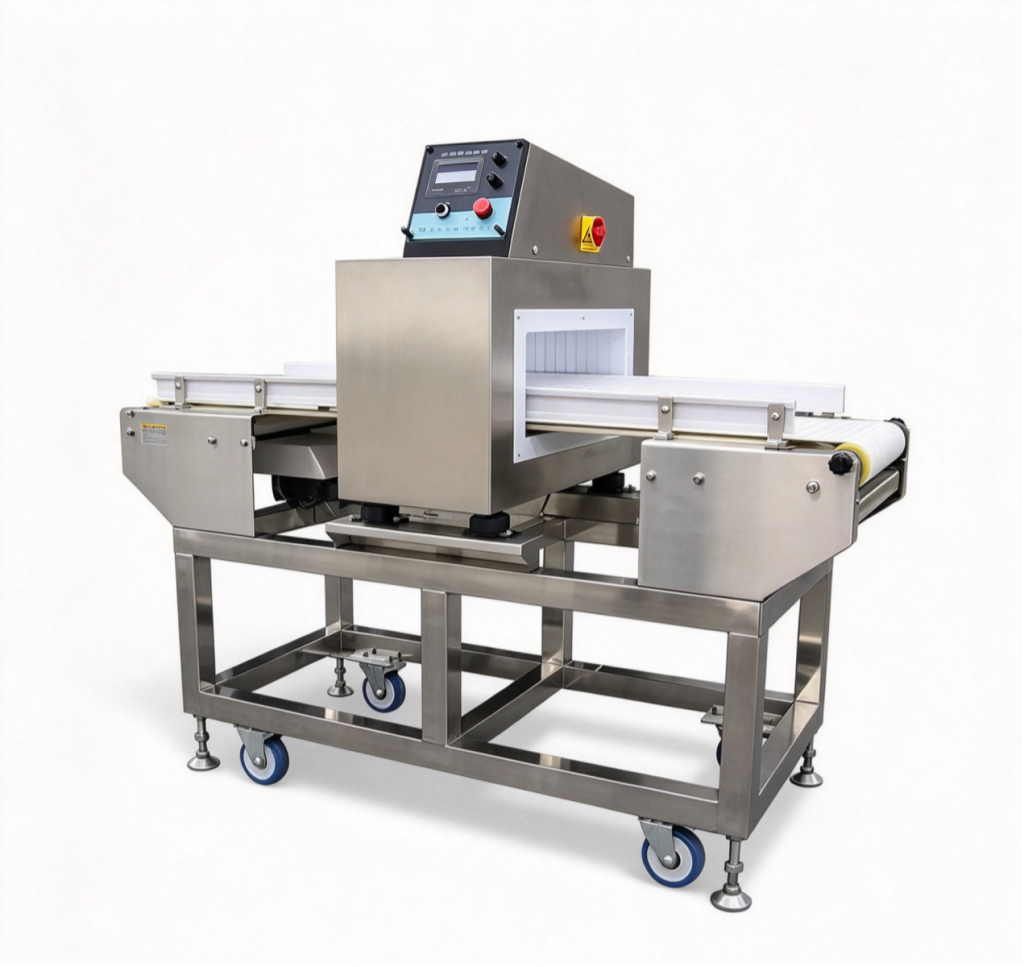
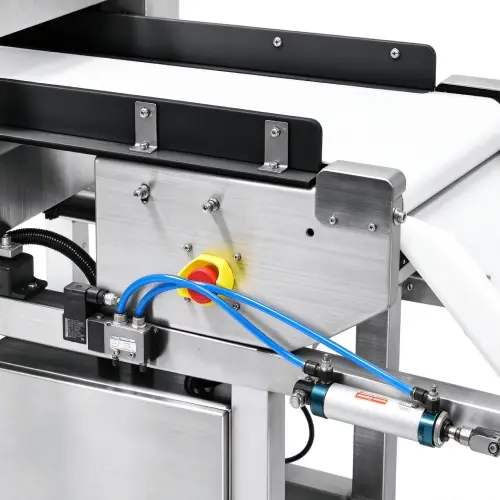
Automatic Food Metal Detector with Conveyor for Production Lines

Product Core Introduction:
Food metal detector is widely used in food production line to inspect packaged or bulk food. It can detect ferrous, non-ferrous and stainless steel impurities mixed in products, effectively prevent metal foreign matter risks and meet food safety standards. All contact parts are 304 food-grade stainless steel, easy to integrate into existing production lines.

Cutting Range1
Capacity1
Contact Material1
Certifications1

Technical Parameters

ParameterValue / Description
Product NameAutomatic Food Metal Detector with Conveyor for Production Lines
Namemetal detector
ModelHIBEST -4010
Rejection systemIndependent reject
MaterialSUS304
Probe materialSUS
Length1900mm
Conveyor belt height740mm
Detecting tunnel width<400mm
Tunnel height<100mm
Sensitivity FeΦ≥1.2mm≥1.2mm
Sensitivity non-metalΦ≥2.5mm
Sensitivity sus Φ≥2.5mm
Detect speed28m/min
Maximum load≤25kg
Power200w
Electric230V/50hz/3p
Detect typesmall package and big package
Machine overall dimension1900x725x1200mm
Standard detection methodalarm shutdown

Finished Products of Equipment

Automatic Food Metal Detector with Conveyor for Production Lines finished product

Performance Advantages

Features and performance depend on the selected machine configuration.

Precision Cutting

High-precision tungsten carbide bardes deliver uniform dice size from 5 mm to 50 mm. Cross-cut and strip-cut modes ensure consistent product quality with minimal giveaway for beef, pork, poultry and fish.


Hygienic Design

Full SUS304/316L stainless steel construction with IP65 waterproof rating. Tool-free blade removal, smooth-surface interiors and CIP-compatible components accelerate sanitation cycles.

High Throughput

Continuous processing up to 3,000 kg/hr with servo-driven in feed control. Modular design allows quick size changeovers in under 10 minutes to match production schedule demands.

Ready to Discuss Your Processing Requirements?

Share your materials, target capacity and project details with our team.

Industry Application Cases

Explore food-processing applications and solution scenarios.
Frequently Asked Questions

Common questions about food-processing equipment and production requirements.

What types of metal contaminants can an automatic food metal detector detect?

An automatic food metal detector is designed to identify metal contaminants such as ferrous metals, non-ferrous metals, and stainless steel in food products. Actual detection performance depends on the metal type, particle size, product characteristics, and machine configuration.

What types of food products can be inspected using a conveyor metal detector?

A conveyor metal detector can inspect a wide range of packaged and unpackaged food products, including meat, poultry, seafood, vegetables, bakery products, snacks, and frozen foods. The suitable configuration depends on the product size, packaging material, production speed, and processing requirements.

How does an automatic food metal detector with conveyor work?

The conveyor system moves food products through a metal detection zone. When the detector identifies a potential metal contaminant, it can trigger an alarm or an automatic rejection mechanism, if equipped. This helps manufacturers identify potentially contaminated products during production.

Can a conveyor metal detector be integrated into an existing food production line?

Yes. An automatic food metal detector can be configured for integration into many existing food processing and packaging lines. Conveyor dimensions, belt speed, product handling, installation space, and rejection system requirements should be evaluated to ensure compatibility with the production line.

What factors affect the detection accuracy of an industrial food metal detector?

Detection accuracy can be affected by metal type and size, product characteristics, moisture and salt content, product temperature, packaging materials, conveyor speed, and machine settings. Regular performance testing and correct calibration help maintain consistent inspection performance under the intended operating conditions.

Can't find your question?

Contact our technical consultants for assistance with your project.

Contact a Technical Consultant

— FREE CONSULTATION —

Get A Free Consultation!

Tell us about your requirements and our team will review your inquiry.

滚动至顶部